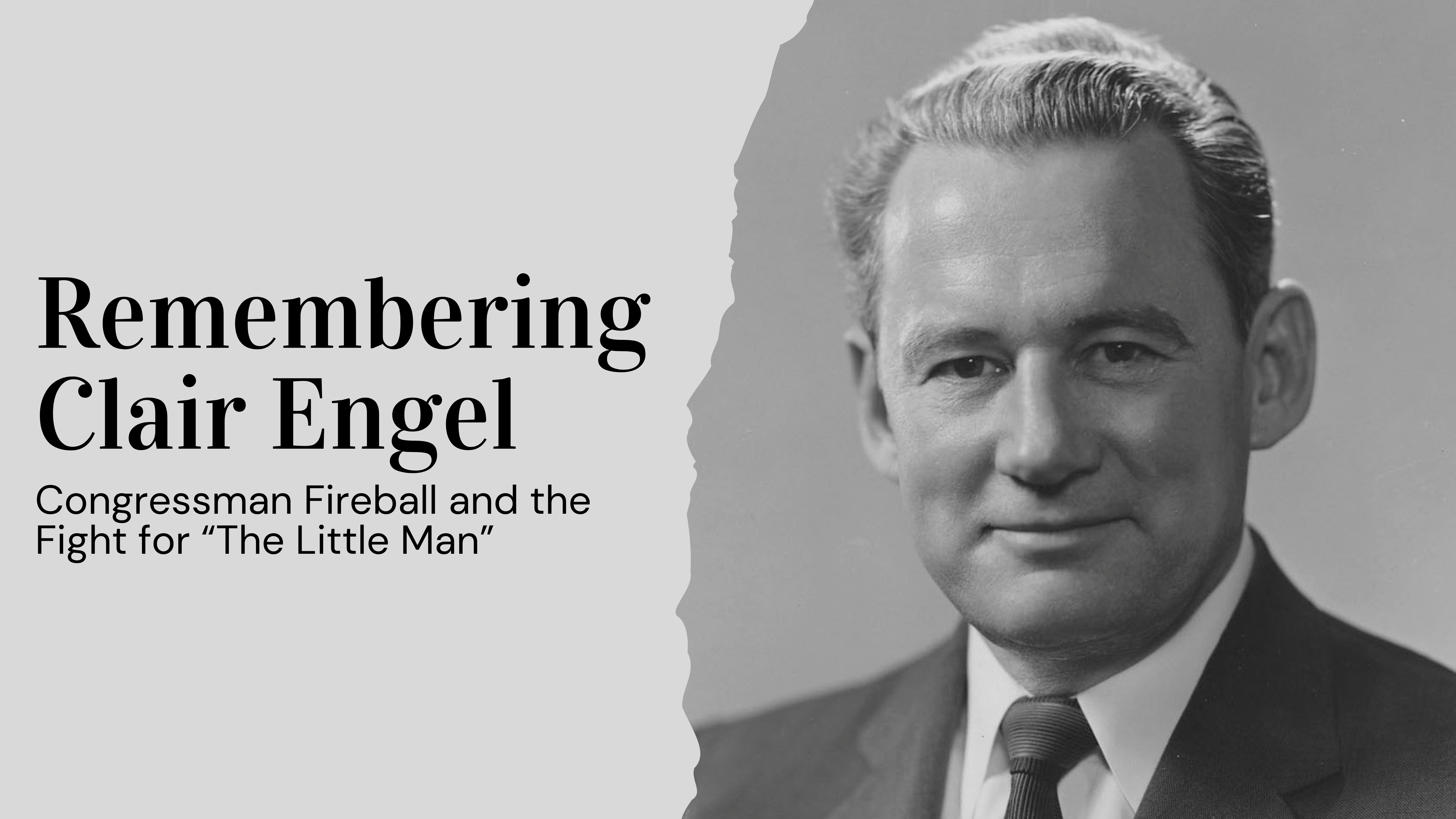
This piece was originally published in the Trinity College Tripod on 9/19/23. It has since been edited and is being shared today in honor of Engle’s birthday.
In 1958, then-Congressman Clair Engle was elected to represent California in the United States Senate.
Engle, the son of a cattle rancher, built a reputation for his political savviness at a young age; he was known for picking fights with bullies and winning a race for school president by rallying students from rural areas against candidates from the town. In 1934, at just 23 years old, he became Tehama County’s District Attorney. He briefly served in the California State Senate before winning a special election to the House of Representatives, in which he served from 1943 to 1959 before choosing to run for the Senate.
He was a casual pilot, an avid fan of cigars, energetic, and outspoken; his manner eventually earned him the nickname “Congressman Fireball.” Despite the bold moniker, Engle was a diligent man and an effective legislator who focused on issues that were anything but fiery: water conservation, irrigation, and mining. He was a conservative, anti-bureaucracy Democrat who always fought for “the little man.” Engle cared about the ranchers and farmers of his state, not the well-dressed but unfamiliar interests that sought to use his voice and his vote. He represented a brand of politics that has faded with time, heavily local and always guided by the contours of the rugged, snow-capped mountains and lush valleys of his home; not uncompromising, but never one to back down from fighting for what he believed in. He was charismatic and unimpeachable, Frank Capra’s Mr. Smith come to life.
In August 1963, nearing the end of what would be his first and only term as a senator, Engle was left partially paralyzed after a surgery to remove a brain tumor. Following persistent health issues and an incident in which he tried to introduce a resolution but found himself unable to speak, Engle abandoned his plans to seek reelection in the fall of 1964. It was soon apparent that he was unlikely to serve out the remainder of his term.
It was a trying time for the nation, but a moment with true potential. America found itself fearful of threats abroad, marching against freedom in a campaign of paranoia as the specter of war loomed over the nation. The Civil Rights Movement had reached a crescendo as Washington finally began to pay attention to calls for the government to take a stand against racial discrimination. As the economic boom of the post-war era faded and the 1960s began, many Americans were eager for change.
Engle, too, was ready for change. His conservative inclination was trumped by his continued fight for “the little man,” and he became a proponent of civil rights legislation, changing with the times and the desires of his constituents.
The moment that defined Engle’s legacy on the national stage would come in the summer of 1964. Proponents of the Civil Rights Act had spent months trying to shepherd the bill through the Senate. It was a complex, bipartisan effort, with leaders in both chambers and outside of its doors, including President Lyndon B. Johnson, lobbying for its passage. Senate Majority Leader Mike Mansfield needed to win over the members of his party, and he had to ensure that Senate Minority Leader Everett Dirksen would not only support but actively fight to secure Republican votes on a key component of the Democratic president’s agenda.
Even with the support of both parties’ Senate leaders, proponents of the bill faced the uphill fight of securing 67 votes to invoke cloture to end debate on the bill and allow it to reach the floor for a simple majority vote, something that modern proponents of civil rights legislation had never accomplished. On the morning of June 10, 1964, Senator Robert Byrd ended his fourteen-hour filibuster, and the Senate embarked on one of the most important votes of the century. Engle, tormented by terminal illness and unable to speak, was adamant that he fulfill his duty. He was transported to the Senate by ambulance.
When the secretary called for the vote of “Mr. Engle,” the Senator slowly raised a hand to his eye and pointed at it thrice, wordlessly casting his vote in favor of cloture on the Civil Rights Act. He would do the same days later when the bill was given a vote of passage. Even unable to speak, Engle fulfilled his duty, doing his part to address a great sin and ensure equal protection under the law for every single American.
It was not until the 96th vote, Delaware Senator John Williams, that cloture was reached; the remaining Senators all voted in favor of cloture, bringing the total vote to 71-29.
50 days after the cloture vote, and 28 days after Johnson signed the Civil Rights Act into law, Senator Clair Engle passed away in his sleep. He was 52 years old.
In the nearly sixty years since Engle’s death, his name has largely faded from public consciousness. He has left behind a relatively tame legacy; the products of most of his efforts are too niche for most Americans to even be aware of them. But that single vote was enough to solidify his name as one that stood for something. Congressman Fireball, flashy in demeanor but sincere in effort, stands as an example of an old sentiment of American politics: that one must fight for those that they represent and for the people of the nation, that one must take a stand for what is right, no matter what it takes to do so.
In today’s politics, there are far too many who reject this notion, be they showhorses or those with ill intent. Television screens are dominated by those with egos too large for the screens they speak through, elected officials who use their positions to drive animus towards those who are so often already the target of it. They stall progress and profit in doing so.
The likes of Senator Engle have quietly vanished. There are fewer and fewer political officials willing to put in the time and energy to better their communities and country. There are even fewer that are willing to take a stand, to fight for what is right even if it means personal sacrifice. The ferocity and breadth of the effort to pass the Civil Rights Act, the joining of forces between political foes, seems unimaginable today, especially for an issue as unfortunately contentious as civil rights. The fight to set aside politics and do good, at both the individual and institutional level, is not what it once was. For many elected officials, the focus of their power is no longer on doing the right thing and displaying courage when it’s necessary to do so; instead, they parrot the party line and use their offices to secure status.
This doesn’t mean that fighters have vanished entirely. They can still be found on the ground, organizing and building movements for change, and there are still many in the halls of Congress; but even in a world that’s more connected than ever before, their efforts are too often drowned out by the rancor of heartless suits more interested in performing than producing something of value.
Engle looked out for local interests, ensuring that he delivered for the people he represented. But, beyond that, he ensured that those who were at a disadvantage had someone to fight for them in Washington — even as he was staring death in the face. He displayed the spirit of a fighter, of someone dedicated to doing the right thing.
As interparty divisions seem to grow even sharper and people’s lives become weapons for political gains, those who seek and wield political power would do well to remember what Engle stood for. Political actors across the nation should take a step back and ensure that they are fulfilling the duties of their positions, and, if they can, going above and beyond in the fight for positive change. Perhaps, in a world with more officials like Engle, the changes that need to be made to secure a better tomorrow will have the fighters that they need to be realized, and the spirit of Congressman Fireball will again prevail.
Image source: Louis Fabian Bachrach Jr. | US Senate Historical Office