At a mid-September gathering of Democrats in Des Moines, Iowa, Senator Chris Van Hollen offered a rare but sharp rebuke of his party.
Van Hollen, a Marylander who’s generally kept a low national profile, has found increased prominence as a staunch opponent of the Trump administration. But on this occasion, he looked in another direction and made an unexpected entry into the debate over another politician: New York Assemblyman and Democratic nominee for mayor of New York City, Zohran Mamdani. The senator endorsed Mamdani, but his message didn’t stop there; Van Hollen criticized his party’s leaders for failing to do the same, characterizing their hesitance as “spineless.”
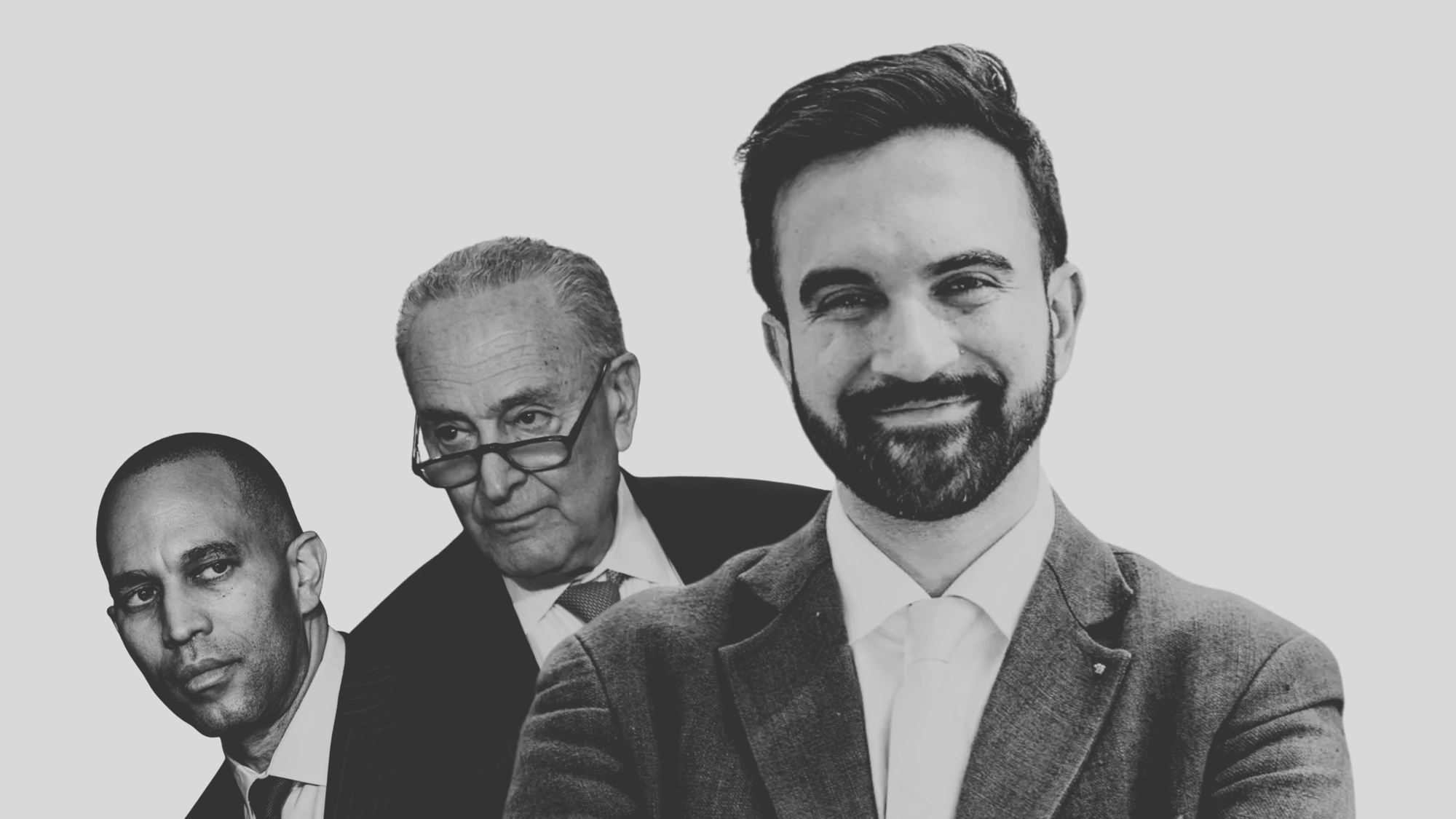
While 2024 Democratic presidential nominee Kamala Harris and New York Governor Kathy Hochul have offered their support to Mamdani, many prominent Democratic leaders have balked. Two names are noticeably absent from Mamdani’s list of supporters: Senate Minority Leader Chuck Schumer and House Minority Leader Hakeem Jeffries, both of whom represent New York. In the two weeks since incumbent mayor Eric Adams’s exit narrowed the race down to three candidates, neither leader has shifted.
As the final month until the election slips by and the Democratic nominee campaigns without the support of many of his party’s leaders, it becomes increasingly clear that Democrats are making a mistake.
Democratic leaders are misreading the moment.
The electorate isn’t happy. The percentage of voters who view the Democratic Party favorably has not risen above 40% since 2023; in the same timeframe, the Republican Party favorability has steadily increased. Favorability ratings within the Democratic Party itself have declined, and now only 47% of voters who lean towards the party have a favorable view of it. For the first time in a decade, a clear majority — 59% — of Democrats disapprove of their congressional leaders. The party’s base and the general electorate feel, quite strongly, that something needs to change. Voters need something to believe in, people and ideas to rally around, and leaders who can carry the torch — and when they look at the party today, they don’t see that.
Mamdani’s primary victory sent an intentional signal. He bested a political titan, a fixture of the Democratic establishment. But, more than that, he broke through the noise. Voters are watching an administration wage war on civil liberties, the safety net, and the very fabric of the American system. Mamdani’s message of hope and possibility, and the authenticity behind it, resonated with New Yorkers and voters across the nation. Whether it was his ideology, the boldness of his policies, his charisma, or simply the belief in something better that his campaign offered to an agitated and dispirited electorate, he won, and decisively. Freshness and a clear, positive vision won.
Many of those who’ve hesitated to accept Mamdani are skeptical of his ideology, as he stands to the left of most of the party. Democratic leaders are hesitant to embrace what their opponents have characterized as extremism, but appealing to moderate voters doesn’t have to mean shunning those on the left. The support and enthusiasm that Mamdani has found evince the hunger for change that now grips Democratic voters of all ideological stripes. Party leaders need to recognize that desire and seek to strengthen the position of leaders who can fire up the base and widen the tent instead of running from them.
After all, the Democratic Party is the big tent party, and its leaders should embrace that fact and the ideological diversity that comes with it.
Since the years of Franklin Delano Roosevelt’s New Deal Coalition, the Democratic Party has been the definitive big tent party in American politics; it’s been a home for voters from all walks of life. But the search for ideological symmetry across its wings has caused a party that could once win elections in any state in the country to bleed support.
With the decline in ticket splitting, sharp division of today, and the way both parties’ coalitions are structured, it’s hard to see how Democrats can win in places like Montana and Mississippi. It will take transformative shifts in American politics and the Democratic coalition for the party to consistently contest seats in the half of the country where it’s effectively locked out of power. But if Democrats want any chance of becoming more competitive nationwide, they have to be more flexible about who runs under their label.
This isn’t to say that Democrats should start backing anyone who wants to use their label. Every Democratic candidate should be expected to support liberal democracy, equal civil and economic rights, and all that flows from those beliefs. Abandoning these principles by tacking right on issues like abortion or gay marriage isn’t worth it. But there’s still room for candidates to break with the national party on some issues if that’s what their prospective constituents would want.
The Democratic Party must reassert that it’s a home for those who’ve been steadfast supporters and the disillusioned and dissatisfied alike, for suburbanites and urbanites, for single black men who hold advanced degrees and go to church every Sunday, and married white women who didn’t go to college and aren’t religious. Democrats fundamentally need to sell their brand as a liberal party that supports equal rights and opportunities for all Americans to all Americans.
The Democratic Party doesn’t need to be just Mamdani’s party — it doesn’t have to be a democratic socialist party. But in New York City, if that’s what its voters want, that’s what it should be. And if Democratic voters in Buffalo, Nassau County, or New York State want the party to be something else, to them it can and should be. This obviously becomes more complicated at the national level, as the Obama and Biden years clearly demonstrated. Still, it’s better to have the numbers to negotiate with than to never find a majority. A big tent party should embrace people like Mamdani and his movement with open arms because the bigger and more welcoming the tent, the more support you can find.
Leaders need to lead.
The role of both parties has diminished with the increased prominence of interest groups and candidates who bill themselves as populist outsiders. But in a time of increased hate, extremism, and destructive approaches to governance, parties need to do more to defend those who are at the receiving end of hate and rage and guide the electorate. Democratic leaders have set an inconsistent standard for when they endorse their nominees and when they don’t, and they need to adopt a more consistent approach. Opting to end endorsements outright could leave candidates without valuable support. Instead, Democratic leaders should just ask three simple questions:
- Is the nominee’s character or conduct in severe question?
- Does the candidate believe in and intend to follow the basic principles of American liberal democracy?
- Would my/our endorsement be helpful?
If the answer to the first two is “no,” and the answer to the third is “yes,” why not endorse the nominee? If the party’s voters want someone with a slightly different ideology than some of the party’s leaders, the party has an obligation to accept that and try to win. Party leaders have every right to try to reshape public opinion, and they must do so to sell their ideology and policy goals, but failing to back their nominees does not further that goal. If anything, it makes Democratic voters feel like their leadership is out of step or absent.
Mamdani has been attacked nonstop by Republicans; Trump has even threatened to arrest him. The fact that his party’s leaders have not rushed to his defense is, frankly, shameful. It’s probable that his position, both as a candidate and as mayor, would be bolstered with the firmer support of his party. But Democratic leadership has failed to provide that, and that failure will not go unnoticed by their voters. Chris Van Hollen certainly understands that.
Democratic voters selected Mamdani for a reason. The party’s leaders need to understand what the base is looking for and recognize the party’s historic place as the big tent party — they need to endorse Zohran Mamdani. The best time to do that was the night that he became the Democratic nominee. The second best time is today.
Image sources:
Shuran Huang | The New York Times
Tasos Katopodis | Getty Images
Jason Andrew | The New York Times